New Track Contains my Shoes

Ever since Nike opened a store in downtown Spokane, I’ve taken my old running shoes in for recycling. They accept not only Nikes, but any type and brand of athletic shoes. They are ground up and used in the construction of running tracks across the country.

While running past Shadle Park High School one day, I saw a sign stating the athletic field would soon close for construction of a new running track. Shadle Park is just a few miles from the Nike store. I intuited shoes from the store would be used in the track. I drew up an action plan to find out.

Using a pair of tin snips, I cut small pieces of metal from a tin can. I spread them atop the soles of a pair of old shoes and put them in the oven, upside down. I grabbed a chair and watched through the oven door as the hot steel chunks sank into the soft, gooey soles. After they cooled, I wrote my initials, JJ, in very dark ink all over the shoes, then took them to the Nike store for recycling.

When the track construction project finished up, I went there with metal detector in hand. I started with lane 1 and went all the way around. No signal. I did lane 2, and it was the same thing. It took over 3 hours, but at the beginning of the backstretch, in lane 5, my metal detector went off. Gently prying at the track, I found some metal chunks, and then I hit pay dirt—just visible were my tiny, handwritten initials.

Now that I know I’m a contributor to the track, I feel I have a right to be recognized. I’ve made an appointment to go in next week to petition school administration. I want to see the name of lane 5 at Shadle Park changed to Jim Johnson Lane at Shadle Park Running Track.
Front Yard Backpacking Adventure

I previously wrote how I converted my front yard to a natural landscape with native plants. It allows me to go for a run in the country or go hiking without leaving home.

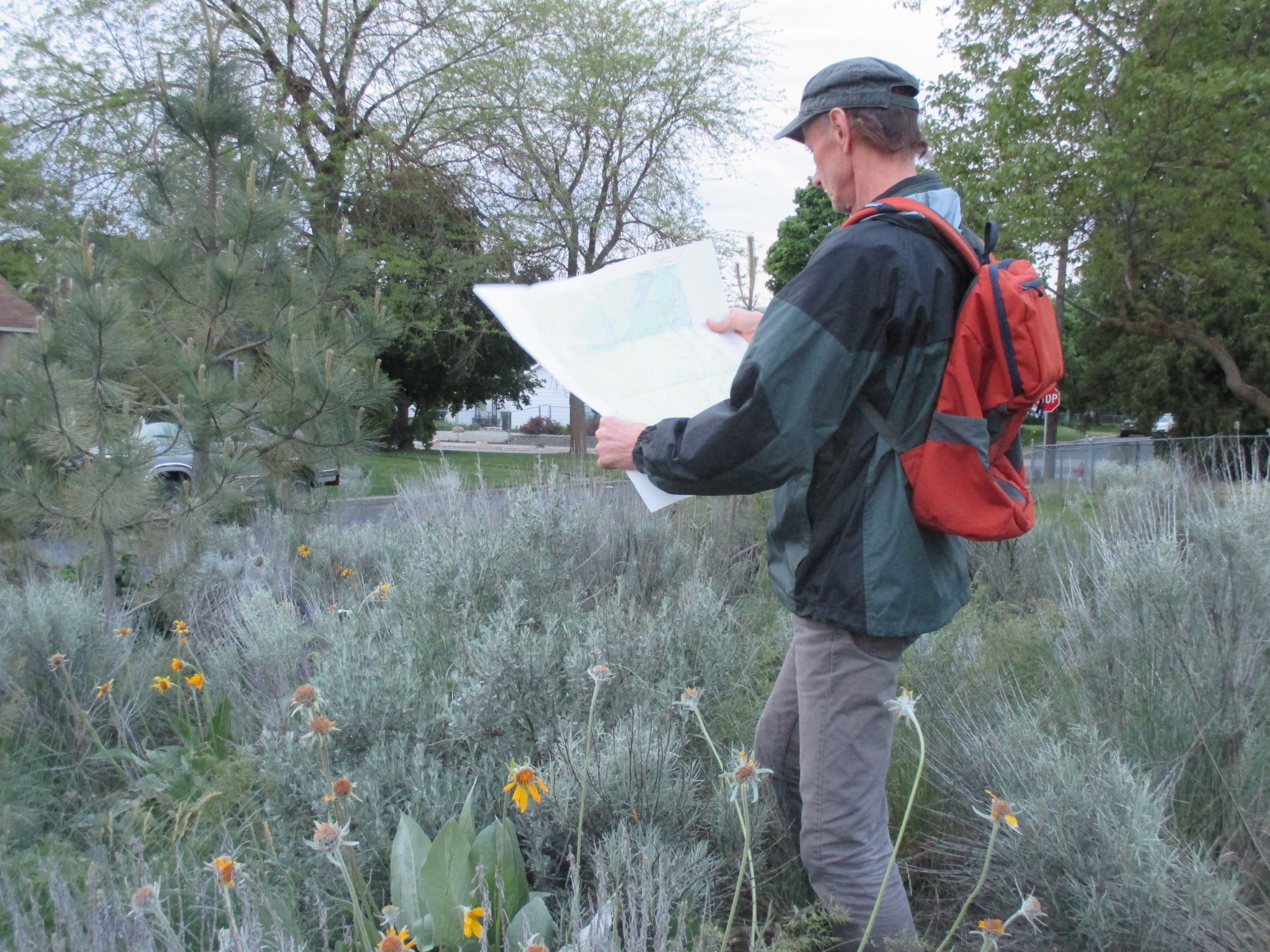
Now that the weather has warmed, I decided to take a short break from running and do a 3-day backpacking trip in my front yard.

On my first night out, I found a nice camping spot with great views of the neighborhood. My simulated campfire made the evening very pleasant.

I broke camp the next day and explored a wild, remote area of my front yard wilderness. It was so densely vegetated, I couldn’t find a good camping spot. I had to set up camp on my sidewalk, but since I packed a good quality pad, I was still pretty comfortable.

On the last day, I covered a lot of ground and was surprised to run into another hiker—my mail carrier. After handing me a couple letters, she offered her pepper spray in case I ran into a bear. I thanked her, but since it was my last day and I was close to the trailhead/front door, I declined.

After 3 long days of hiking, I was dead tired. However, I so appreciate a front yard where I can slow down and smell the lupines and arrowleat balsamroots.

We Must Run in Snow

Many runners who live in places that get snow think it’s a treat. Running as snow is falling is especially charming. The landscape is also visually appealing. If the snowpack is fluffy and deep, it provides a very soft cushion when you slip and fall. What would’ve been a broken rib is just a bruised one instead.

When the snow starts piling up, you’ll find me running on my front yard trails.

Not all places get snow, which is very rude of Mother Nature; however, there are ways around this. If you run to the arena, where the hockey team plays, or to an ice skating venue, the Zamboni dumps ice shavings, a very close facsimile of snow at the rear of the building. Not only can you find joy running in the soft, slushy pile, you can do some glissading, bringing about a spike in fun levels.

Looking in the distance is another way to find snow. The rain that fell overnight may have come down as snow in the nearby mountains. When their tops turn white, it’s time to call your friends, dress in festive seasonal apparel and take a group photo before caravanning to the mountains.

You can count on a day of delightful schussing, snowballing, and wild, snow running, sure to provide many, hilarious, face-planting spectacles.

Run With Bees? No! Run From Monsters? Yes!

Mt. Sentinel at left, from Polaris Pass. Photo by Erik Smith

Does Running Cause an Early Death?

It’s long been said running is good for you and can add years to life expectancy; however, it doesn’t always work out that way.

The past few years, longtime runners I knew or knew of died early. When I say early, they made it to retirement age or close to it, but died of disease short of the average life expectancy for Americans (74.8 yrs for men; 80.2 for women). These runners not only didn’t add years to their lives, years got taken off.

(Before moving on, how about a macabre photo to match the topic of this post.)

I used to have a copy of “The Complete Book of Running”, written in 1977 by Jim Fixx, who became famous for his running knowledge and promoting its health benefits. Most longtime runners know Jim Fixx died of a heart attack, (while running, at age 52).

Jim Fixx had a congenitally-enlarged heart, and an early death by heart attack ran in his family. Longtime runners who die early could be genetically pre-disposed, thus running may lengthen life only a little, or not at all.

I brought up this topic with a few acquaintances in the running groups I join. We agree it’s not unheard of for runners to experience heart problems as they age. This seems so unfair. It’s like sticking to a low-fat diet and then finding out you have clogged arteries and need heart surgery. Or avoiding sun exposure and always using sunscreen, then getting skin cancer.

I found I needed a little reassurance as I assumed my diet and physical activity would be a strong antidote to age-related disease.

I found a couple reviews of studies done on the impact of running (Done by Harvard Health and Spring Link, respectively) that shows regular, moderate running has many benefits, including a longer life. On the other hand, UER (ultra-endurance running), increases chances of long-term health problems, including cardiovascular disease, though overall, health outcomes are better than non-runners.

This issue comes about because I’ve reached the point in my life that the end of it is not so far off. Age-related conditions come about that you never consider when younger. I think it’s natural to contemplate how things will go in the latter part of one’s life and strive to make it as pleasant as possible.

Talking with Jim Hoppe, a veteran of Spokane running clubs. Photo by Dominic Bartoletta.

So, there’s really nothing more I can do. As I’ve written before, I don’t necessarily want to live a long life, but while I’m alive, I’d like to be healthy and active.

The cemetery photo was taken by an acquaintance after a forest fire very close to Spokane last month. The headstones aren’t stained with blood, but fire retardant. Perhaps I can find hope by thinking of my situation the same way—worries about health problems are like red-stained headstones—appearances that aren’t as bad as they look.

Intriguing Lecture Event Scheduled

With the weather getting warmer, bugs are coming out. It’s motivated me to schedule a much anticipated lecture in which I talk about bugs I see while running.

Some readers may recall I gave such a lecture several years ago, and you may be wondering why I’ve waited so long to schedule another. I apologize for the wait. Though I know the names of common bugs, I have no idea what most are called. To make up for it, I’ll give very, very detailed descriptions. I’m also reserving time near the end of the five-hour event for participants to share their own bug sightings.

So start paying attention while you’re out running. Bug sightings can include just one bug or a whole swarm. I doesn’t matter if they’re airborne, scurrying about on the ground or just sitting there, motionless. Descriptions of dead bugs are also welcome.

Though I’ll limit my descriptions to sightings made only in the past year, I’m including information about the epic ant horde of 2022 that was so thick, you couldn’t see the corner of my sidewalk in my backyard.

I’ve reserved a large space as I expect interest for this event to be intense. I urge attendees to make reservations quickly to guarantee a seat.

I’m sure after watching the friendly invitation in the below video, you’ll rush to make arrangements to attend my big, can’t miss, bug lecture.

“Come to my bug lecture. You’ll find it interesting and exciting!”

Wildlife Encounter Knocks me to the Ground

In a post last year, Mysterious Animal in my Front Yard, I wrote about a creature that took up residence in my front yard. Even though many people don’t believe they exist, I’ve concluded the animal is Sasquatch, also known as Bigfoot.

My efforts to catch sight of the Sasquatch have failed over the months – until now. Last week I was doing a run on my front yard running paths when I collided with something that knocked me to the ground.

I couldn’t understand what happened because there was nothing in my path to collide with. When I looked back, I had the shock of my life. Standing not ten feet away was Sasquatch, glaring at me. My front yard cam captured the image below.

The stare down lasted but a moment – the Sasquatch darted away, and by the time I got to my feet, he had vanished. I was mystified how he could appear and then disappear so quickly. It’s like Sasquatch have magical powers. Unfortunately, he was just outside the viewing range of my front yard camera.

It’s hard keeping such an amazing experience to myself. However, when I tell others, I’m mystified yet again. You’d think my eye witness account would result in astonishment and follow up questions. Instead people laugh or act like I’m trying to pull a fast one on ’em.

In the below photo, my amazing Sasquatch experience is causing fellow members of the Manito Running Club, Madeline Reich and Mike Tonkyn, to laugh non-stop.

Madeline laughed so hard she got a stomach ache. I heard Mike laughing on and off the entire run.

I’ve been nicknamed Sasquatch Jim, and asked when I’m going to get to the bottom of other mysteries like the Loch Ness Monster and aliens. This infuriates me. How can I solve the Loch Ness monster mystery? I don’t live in Scotland. And why would Sasquatch Jim take on aliens? I have no reason to get involved with aliens unless I saw them living in my front yard.

If I happen to run into any of you readers, I’ll expect the utmost in respect and consideration as I tell my story. If not, Sasquatch Jim will get very, very, angry.

A Hot, New, Running Accessory – Binoculars

Used to be I didn’t carry any sort of device while running. However, because I really want to be a fancy boy, I’ve positioned myself at the forefront of a new trend—carrying binoculars while running. More about this in a minute.

A couple women once complimented me for not getting sucked into carrying a device that has GPS tracking. They told me sometimes the pleasure of running is lessened by giving so much attention to all the stats a device gives.

I had to deflect the compliment because the reason I don’t carry a device is that I lack initiative. Sometimes I am interested in the pace or the distance, and I’ll ask someone I ran with who has one.

Usually, judging my pace and distance works for me, and I can often be pretty close. It’s only recently that I finally started using any kind of device—a headlamp for nighttime running.

In a post from earlier this year, How to Become a Really Slow Runner, I detailed how I’ve slowed down immensely. This is the real reason I run with binoculars—not because I’m trying to be a fancy boy.

When I’m unfamiliar with the route at a running club get-together and I’ve fallen way behind everyone else, I can keep the group in sight. This means search and rescue can have a pleasant evening at home instead of looking for me.

Mysterious Animal in my Front Yard

Several times over the past few weeks, I’ve been awoken in the middle of the night by an animal in my front yard grunting and making high-pitched howls.

I transformed my front yard from lawn to native vegetation about 15 years ago. I also made paths so that when I want to go for a run out in the country, I head to my front yard.

I really wanted wildlife in my front yard wilderness, so I hired a consultant, Ruby Redpepper. To evaluate its suitability, she used a cat-like animal native to South Africa that’s an indicator of habitat quality. To my delight, she explained that despite the small size of my yard, it’s so high-quality, a concentrated diversity of wildlife will thrive.

She was right. Over the years I added animals that she suggested. With binoculars in hand, I did a day-long hike hoping to find out what mysterious animal has made a home in my yard.

I was able to get photos of a few animals. I saw several deer. This one lives near my front porch.

I came across a marmot. He lives just outside my bedroom window.

A red-tail hawk has a nest in one of my pine trees. He’s often perched on an old TV antennae on my roof looking for a meal.

I saw a snake near the front curb.

Then I came across the remains of a rabbit. I knew just the person who could identify the predator that got it.

I guessed it was a coyote or fox, but after examining the photo, Ruby Redpepper said a very large and controversial animal did it, but refused to say what.

The remains and the middle-ot-the-night noises were still a mystery, along with why Ruby Redpepper declined to identify the predator. A few days later, I caught a glimpse from the corner of my eye and couldn’t believe what I saw. Searching further, I found evidence I was not imagining things.

This footprint is almost 3 times bigger than mine. Obviously it’s bigfoot. Apparently my front yard wilderness is such terrific habitat a bigfoot was drawn to it. But how did it find my yard?

Several days later, I got my answer when I came across this house less than a mile from mine. I’m guessing the population density got too high and one moved on.

I’d really like to observe my front yard Sasquatch. Like people who put up bird feeders to attract birds, I’m going to put up a Sasquatch feeder by my front window. I’m not sure what Sasquatch eat, but I bet they like fruit. I’ll start with that.

How to become a Really Slow Runner

Most runners like to push themselves to get a good time or finish well. Very few choose to meander at a really, really, slow pace. It’s boring, and it takes a long time. If you’re in a race, finishing after the finish line fixtures have been taken down and nobody’s around is not appealing. Running extremely slow may appear comical to others. And if it’s cold, you can’t generate enough body heat to stay warm.

I’ve been exploring the nooks, crannies, and pits of being a slow runner, and I’m not even intentional about it. An unavoidable consequence of aging, I keep hoping I can overcome it and still be kinda fast, sometimes.

Some days, not only do I run slow, I have a hard time just running. There’s no injury, pain or fatigue from a recent workout. My age has caused my body to sometimes have a negative reaction to running. Almost always I do a warm-up before a running group run. Despite my very slow warm-up pace, the resistance can be so great, and I feel so lousy, I have to walk, hoping the break will help me feel better. This can happen multiple times during my warm-up. It’s especially bad on morning runs as I’m not a morning person.

Even after my warm-up, it’s not unusual during the group run for me to see someone running really slow, and it really strikes me how slow they’re going, yet they’re ahead of me and pulling away. It’s demoralizing.

Yet sometimes I can run at a decent pace for someone who’s 66 years old. This brings me hope my running can stay satisfying enough that I’ll continue to run. However, there have been times I felt so lousy that If it became the norm, I’d give up or drastically reduce my running.

On the plus side, I realized I’ve done enough slow running that I’ve become well-qualified to teach runners who want to learn how to run really slow. This has turned into a neat opportunity, and for the past several months I’ve been working on the most effective methods for teaching this skill. Now I’m ready to offer instruction.

If you’d like to enter my program, you’ll find there’s much more to running very slow than you’d imagined. Becoming proficient may cause you to happily dedicate yourself to lifelong slow running. However, after joining my program, you’ll be asked to work on a couple mental barriers that must be overcome. These are non-negotiable requirements:

  • An attitude often used when doing a job or task – I’m making good progress must be eliminated from your mindset and replaced with It’s hard to tell if I’m making any progress.
  • Doing something with the idea that it won’t take long must change to This is going to take a long, long time.

My program involves both in-class study and field work. Analyzing video is key. Below is one sample that both inspires participants and shows what’s possible by the end of the program.

MVI_2976

I contacted Washington State University, submitted my curriculum, and it has been accepted, and my course is certified. It will be offered at the WSU Spokane campus beginning next semester. For those of you interested in learning how to run really, really slow, I look forward to seeing you soon.